Thoughts for our day
The Anaphora of St. Basil tells of the whole story of our relationship with God.
The story of the Garden of Eden reveals that as human beings, we have not trusted God, but instead thought that we could achieve glorification by our own efforts. By being unfaithful to the divine plan, “man disobeyed you, the true God who created him; he was led astray by the deceit of the Serpent, and by his own transgressions was subjected to death.”
Following Christ with a sense of moderation
Glory to Jesus Christ!
I remember a distinct moment in eighth grade when Sister Basil, at the beginning of the school year, said to us, “Please know that I pray for you every day.”
Then she said something shocking. She said, “In my prayers, I pray any of you that do something wrong will be caught immediately.”
Hair today, gone tomorrow
I saw an interesting question going around on Twitter the other day: What changes in your life that have been necessitated by being quarantined may carry over whenever our lives get back to normal?
(Or, as normal as can be expected, that is.)
There were a variety of intelligent comments. Some people may continue to work from home, if possible and permitted by their boss.
The First Commandment: I am the Lord Your God
Christ is Risen! Indeed He is Risen!
My dear brothers and sisters in Christ, we continue this series of articles in the field of Moral Theology. One of Moral Theology’s most important lessons is the Decalogue (literally Ten Words) or the Ten Commandments. I am sure you remember them from your catechism classes but let me review them so you may reflect on them for yourselves.
Very often when we hear about the Ten Commandments, we immediately imagine something negative, something that prohibits us from doing something: “Don’t do this or don’t do that.” Yet at the same time, we overlook why God gave the Decalogue to the people.
In Chapter 20 of the Book of Exodus, we read God was a protagonist and gave the commandments to the Jewish people because of His love for them. The Decalogue served as a sign of the Covenant, a sign of God’s love for the Jewish people. By keeping the Ten Commandments, the Jewish people accordingly declared their love for God and obeyed God’s word because of His love.
With the coming of Jesus Christ, scripture inherited a universal character. It also offered the world a new and everlasting Covenant, one established through the suffering, death, and resurrection of our Lord Jesus Christ for the benefit of all nations. “For God so loved the world that he gave his only Son so that everyone who believes in Him might not perish but might have eternal life” (John 3:16).
At morning mass, Pope offers prayers for unemployed
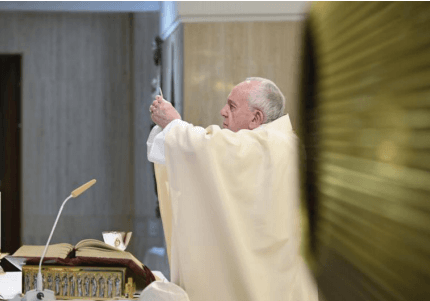
VATICAN CITY — As countries continue to reel from the economic fallout of the coronavirus pandemic, Pope Francis offered prayers for the men and women who have been unable to work.
“In these days, many people have lost their jobs, were not rehired, or work off the books. Let us pray for these brothers and sisters of ours who are suffering from this lack of work,” the pope said May 11 at the start of his Mass in the Domus Sanctae Marthae.
Thoughts for our Day
The feast of Pentecost is the closing day of the Feast of Pascha, the Resurrection of our Lord. In the Acts of the Apostles, the Holy Spirit came upon the followers of Jesus in the form of tongues of fire. This was the fulfillment of the prophecy of John the Baptist, “I am baptizing you with water, but one mightier than I is coming. I am not worthy to loosen the thongs of his sandals. He will baptize you with the holy Spirit and fire” (Luke 3:16).
Modesty invites us to to recognize our blessings
Glory to Jesus Christ! Today I continue the series on the Fruits of the Spirit and I start with this question: Have you ever given a compliment to somebody who doesn’t know how to handle a compliment?
Contemplating God’s importance in our lives
May the Peace, Love, and Grace of our Lord Jesus Christ be with all of you!
My Dear Brothers and Sisters in Christ, very soon we will celebrate the greatest feast for all Christians — the Resurrection of our Lord, God, and Savior Jesus Christ!
Pope calls for a “contagion” of Easter hope
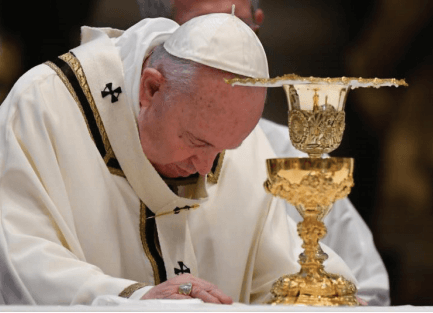
MILLIONS FOLLOW EASTER PRAYERS ON TELEVISION, RADIO, INTERNET
VATICAN CITY — In an Easter celebration like no other, Pope Francis prayed that Christ, “who has already defeated death and opened for us the way to eternal salvation,” would “dispel the darkness of our suffering humanity and lead us into the light of his glorious day, a day that knows no end.”
The pope’s traditional Easter message before his blessing “urbi et orbi” (to the city and the world) still mentioned countries yearning for peace, migrants and refugees in need of a welcoming home and the poor deserving of assistance. But his Easter prayers April 12 were mostly in the context of the suffering and death caused by the coronavirus and the economic difficulties the pandemic already has triggered.
The pope’s Easter morning Mass was unique; missing were dozens of cardinals concelebrating and tens of thousands of pilgrims from around the world packing St. Peter’s Square. Instead one cardinal — Cardinal Angelo Comastri, archpriest of St. Peter’s Basilica — and a dozen faithful sat inside, one in each pew, before the Altar of the Chair where the pope celebrated the liturgy.
Also missing were the more than 50,000 tulips, daffodils and flowering shrubs that growers in the Netherlands donate each year to turn into a garden the steps leading up to the basilica.
Pope makes mini-pilgrimage outside Vatican to pray for end of pandemic
ROME — With Italy on lockdown and Rome streets almost deserted, Pope Francis left the Vatican March 15 in a mini-pilgrimage to an icon and to a crucifix associated with miraculous interventions to save the city and its people.
The icon is “Salus Populi Romani” (health of the Roman people) in the Basilica of St. Mary Major and the crucifix, which Romans call the “Miraculous Crucifix,” is housed in the Church of St. Marcellus on Via del Corso, a usually crowded street of shops leading to the central Piazza Venezia.