Thoughts for our Day
The A n a p h o r a of St. Basil is read in the Divine Liturgies of the Great Fast and also on the Great Feasts of Christmas, Theophany and Pascha. The reason for this is that it is the most sublime statement of faith in our Liturgy. In it the whole story of our salvation in Christ is told, and, hearing it, we learn the basic message of the gospel. I’ve entitled these articles “our catechesis,” but they are more properly what is called “mystagogy,” the proclamation of faith by baptized, committed Christians. In the most holy times of our liturgical year, we tell how God has brought us salvation. It is more than instruction, it is our worship and confession of life in Christ. In the next few articles, I want to show how this story is told.
Lenten Saturday Morning at the Mount
The Byzantine Catholic Serra Club chose to join with other registrants March 7 at Mount St. Macrina House of Prayer in Uniontown, Pa. for their annual Lenten Retreat Day.
The Lenten Saturday Morning was led by our chaplain, Father Valerian Michlik, who had been invited by the Sisters of St. Basil the Great to present the conference. Serrans comprised 21 of the 30 registrants.
“A person of faith is always concious of God”
Glory to Jesus Christ!
As we continue this series on the fruits of the Holy Spirit, we look today at “faith.”
Last weekend, I had the joy of being with a convocation of young adults in the Eparchy of Passaic in New York City, We were challenged on Saturday afternoon to go forth into the city and to take our faith and make it known.
Approach with fear of God and with faith
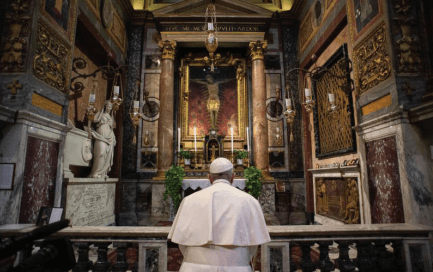
My name is Father Vasyl Symyon, originally from the Byzantine Cathol i c Eparchy of Mukachevo, Ukraine, and currently a Byzantine Catholic priest within the Byzantine Catholic Archeparchy of Pittsburgh.
I have served as pastor of two wonderful parishes in the Archeparchy for nearly five years. And during my time here, I have been asked by many of my parishioners about the need to confess their sins. Questions such as: “What must I say when I come to confession?,” “What do I have to confess?,” “Of what I believe I do wrong, are some
of them really sins?,” “What is the definition of a grave sin?,” “What is a venial sin?,” and “When and how often do I have to go to confession?”
With those questions in mind, this article is the first in a series through which I will provide important answers to important questions in the field of moral theology and bioethics based on the teaching of the Catholic Church. Therefore, I hope to enlighten all readers to grow their spiritual lives, enhance their holiness and help them reach the Kingdom of God.
As significant material for this article, I referenced a very important document of the National Conference of Catholic Bishops of the United States. On Nov. 14, 1996, the National Conference of Catholic Bishops approved a document, “Guidelines on the Reception of Communion,” which teaches us:
“As Catholics, we fully participate in the celebration of the Eucharist when we receive Holy Communion. We are encouraged to receive Communion devoutly and frequently. In order to be properly disposed to receive Communion, participants should not be conscious of grave sin and normally should have fasted for one hour. A person who is conscious of grave sin is not to receive the Body and Blood of the Lord without prior sacramental confession except for a grave reason where there is no opportunity for confession. In this case, the person is to be mindful of the obligation to make an act of perfect contrition, including the intention of confessing as soon as possible (canon 916). A frequent reception of the Sacrament of Penance is encouraged for all.”
Long-suffering is being patient
Today, as we continue this series on Fruits of the Spirit we talk about one we wonder if it belongs here; it’s called “long-suffering.”
It’s considered something good in the Catholic tradition; in the spiritual tradition, actually, because we are a church of martyrdom and a people who are faithful to the end.
Audience with Pope Francis
VATICAN CITY — In January, when Cardinal Robert Sarah, prefect of the Congregation for Divine Worship and the Sacraments, published a book supporting mandatory priestly celibacy — a book, which included an essay by retired Pope Benedict XVI – it was “painful,” said Bishop John M. Botean of the Ohio-based Romanian Catholic Eparchy of St George.
True sorrow for sins leads to renews love for God, others, pope says
VATICAN CITY — Recognizing and repenting for one’s own sins and errors is difficult, but essential, Pope Francis said.
“To understand (one’s) sin is a gift from God, it is the work of the Holy Spirit” who helps each person realize “the evil I have done or that I may do,” the pope said Feb. 12 during his weekly general audience.
Pope adds year of missionary service to Vatican diplomats’ training
VATICAN CITY — Pope Francis, adopting a suggestion made at the Synod of Bishops for the Amazon, has decided that every priest preparing for service in the Vatican diplomatic corps must spend a year in ministry as a missionary.
“I am the good shepherd”
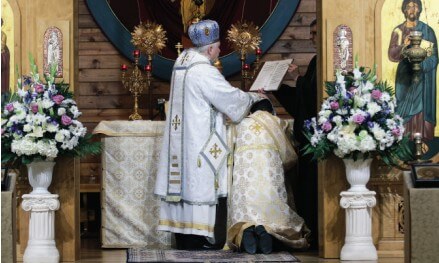
Deacon Thomas Wells was ordained a priest forever by Metropolitan Archbishop William C. Skurla during the Divine Liturgy on Saturday, Jan. 18 at his home parish of St. John Chrysostom in Houston, Texas.
Concelebrating with the Metropolitan were Very Rev.Elias L. Rafaj, administrator of St. John; Very Rev. Robert M. Pipta; Rev. Father Janucz A. Ihnatowicz of the Latin Archdiocese of Kraków, Poland; and the Rev. Father Fadi Al Mimass of the Melkite Mission of St. Barbara in Houston.
The parish Deacon Andrew Veres; Deacon Brian Norrell of St. Basil in Irving, Texas; Sub-deacon Bryan Scotton of the Passaic Eparchy; and Subdeacon Jamil Daaboul of the Melkite Mission assisted.
Deacon Jeffrey Mierzejewski served as cantor. Also serving at the altar were Father Tom’s son, Michael; his son in law William Peacock; and parishioners Ryan Black, Will Colbert, Phillip Kaye, David Dominguez and Angelo Luna.
In his homily, Archbishop William noted that “I am the good shepherd. A good shepherd lays down his life for the sheep. A hired hand, who is not a shepherd and whose sheep are not his own, sees the wolf coming and leaves the sheep and runs away, and the wolf catches and scatters them. This is because he works for pay and has no concern for the sheep. I am the good shepherd, and I know mine and mine know me, just as the Father knows me and I know the Father, and I will lay down my life for the sheep.
Calling all young writers!
Near the beginning of the film “A Beautiful Day in the Neighborhood,” writer and reporter Lloyd Viogel (Matthew Rhys) is accepting an award for one of his stories. Lloyd begins […]